Studies Recruiting
High-tech augmentative and alternative communication for childhood dementia
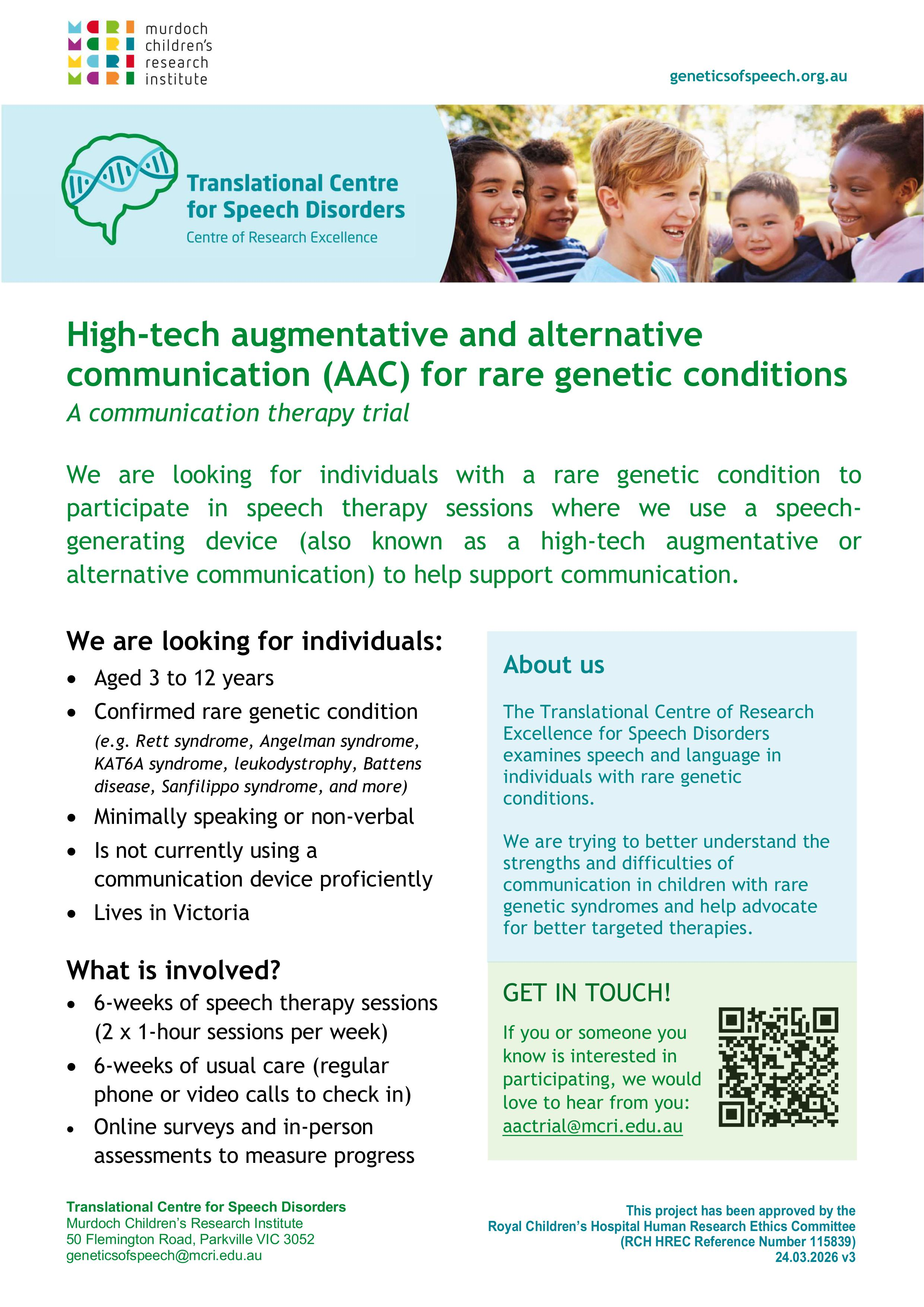
We are recruiting individuals with a rare genetic condition to participate in a communication therapy trial.
We are looking for individuals:
• Aged 3 to 12 years
• Diagnosed with a rare genetic condition
• Minimally speaking or non-verbal
• Not currently using a communication device proficiently
• Living in Victoria
What’s Involved:
• 6 weeks of speech therapy sessions (2 x 1hour sessions per week)
• 6 weeks of usual care
• Online surveys and in person assessments to measure progress
If you are interested in participating please register your interest here or if you have questions please email us at aactrial@mcri.edu.au
Seeking parents and health/education workers views on a new tool assisting speech pathology referral
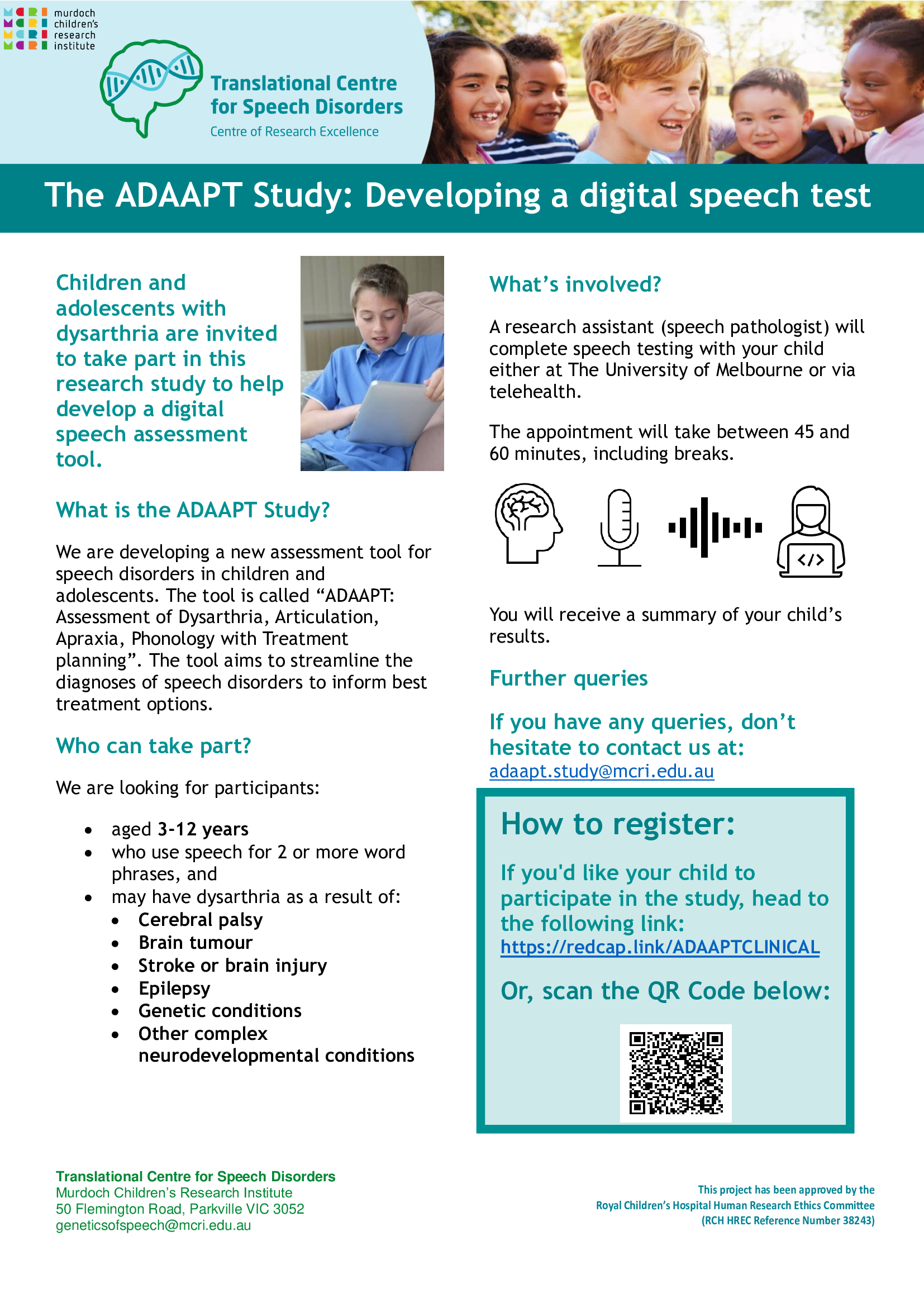
We are recruiting children with dysarthria to take part in our research study. This involves a speech assessment with a speech pathologist and report.
We are looking for individuals:
• aged 3-12 years old
• who use speech for 2 or more word phrases
• have dysarthria
What’s Involved:
• speech assessment anticipated to take 45-60 minutes
If you are interested in helping our research, please email us at adaapt.study@mcri.edu.au or use the link here
Seeking parents and health/education workers views on a new tool assisting speech pathology referral
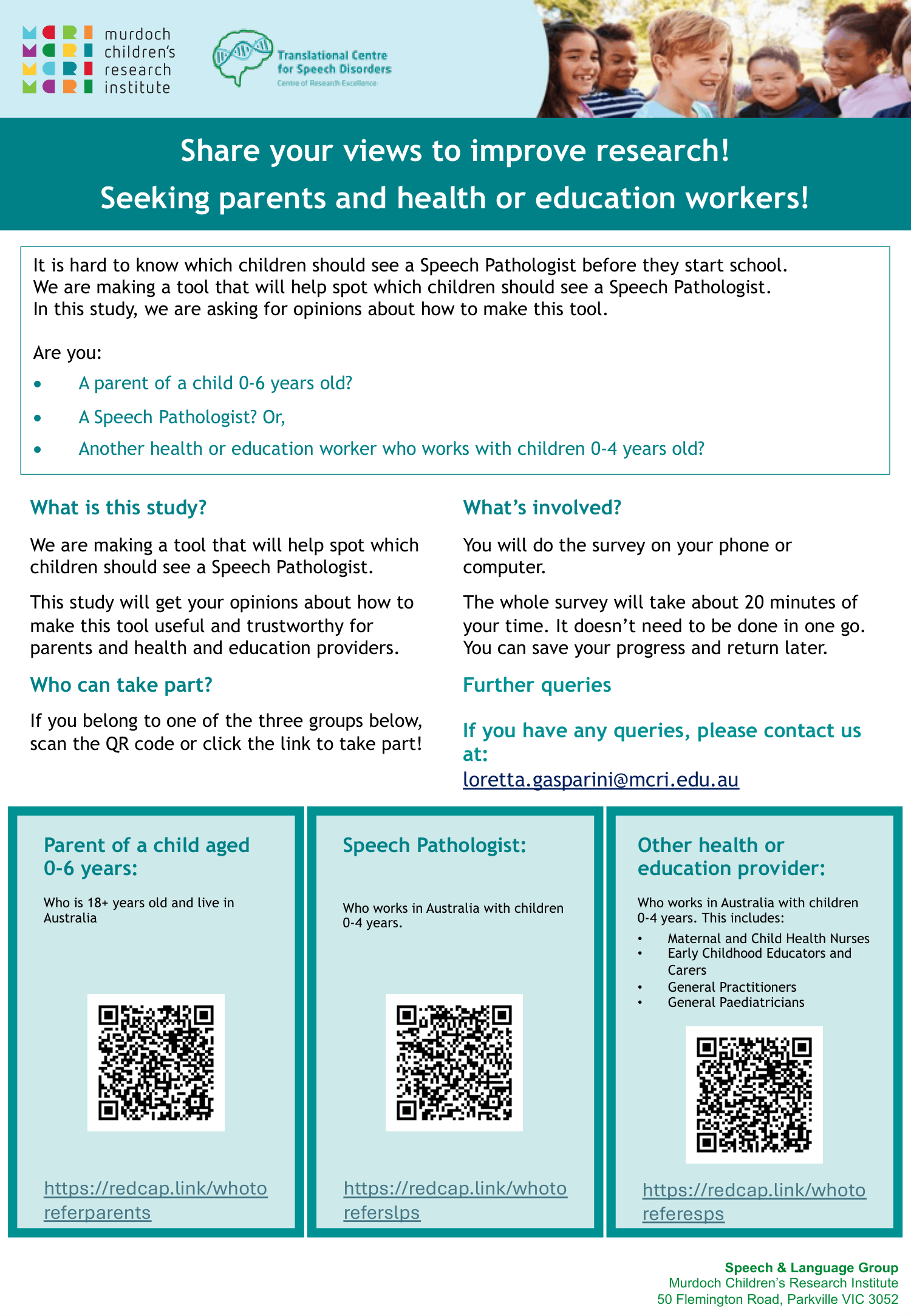
The MCRI Translation Centre for Speech Disorders is making a tool to help spot which children need more help with their language. We are seeking views from:
• Parents of children aged 0-6 years,
• Speech Pathologists, and
• Other health and education workers, who work with young children (0-4 years).
You will do an online survey. This will take about 20 minutes of your time.
To register, please scan the QR code below or follow the link:
• Parents: https://redcap.link/whotoreferparents
• Speech Pathologists: https://redcap.link/whotoreferslps
• Other health and education workers: https://redcap.link/whotoreferesps
To learn more, email us at loretta.gasparini@mcri.edu.au
Genetic counsellors' experiences and support needs: working with individuals with speech or language disorder
We are recruiting genetic counsellors for a new study exploring experiences working with patients with speech and/or language disorders.
As genetic counsellors work to support a wide range of individuals and families, and we prepare for the clinical integration of genetic testing in speech disorder, we hope to understand support needs for genetic counsellors in this field.
We are looking for individuals:
• Any currently, or recently, practicing genetic counsellor in Australia
• With or without experience working with patients with speech or language disorder
What’s Involved:
• Participation involves completing an interview via Zoom, anticipated to last for up to 60 minutes
If you are interested in helping our research, please email us at aiden.botha@student.unimelb.edu.au or use the link here
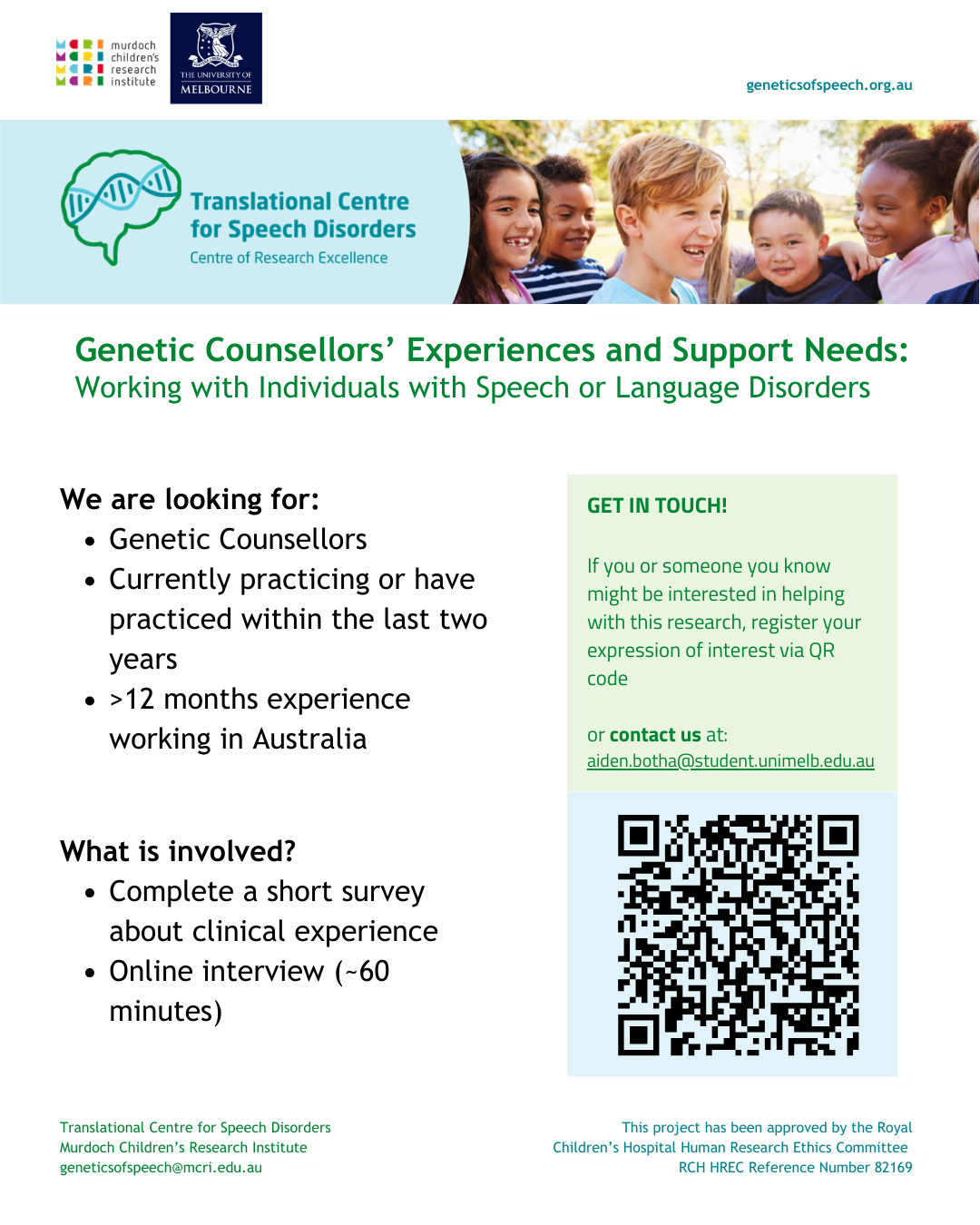
Speech and language in individuals with CACNA1C-related disorders including Timothy syndrome and long QT type 8
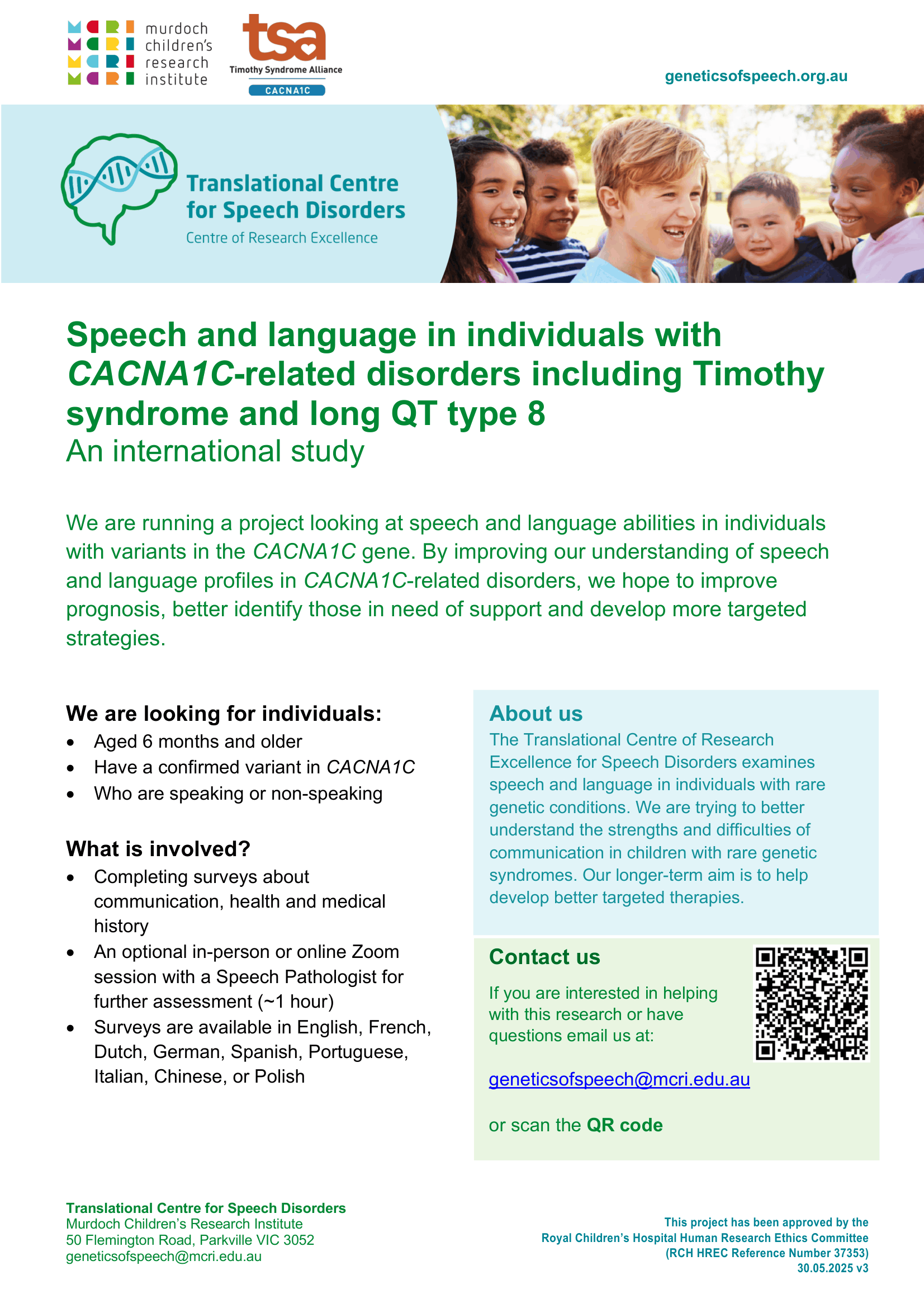
We are launching a new study looking at speech and language in individuals with CACNA1C gene changes
We are looking for individuals:
• Aged 6 months to adulthood
• With a CACNA1C variant confirmed by genetic test
• All communication abilities (speaking or non-speaking)
What’s Involved:
• Surveys about speech, language and health
• Online or in-person meeting with a speech pathologist, including a speech assessment where possible
Surveys are available in English, French, Dutch, German, Spanish, Portuguese, Italian, Polish and Chinese
If you are interested in participating or have questions, please email us at geneticsofspeech@mcri.edu.au or sign up here
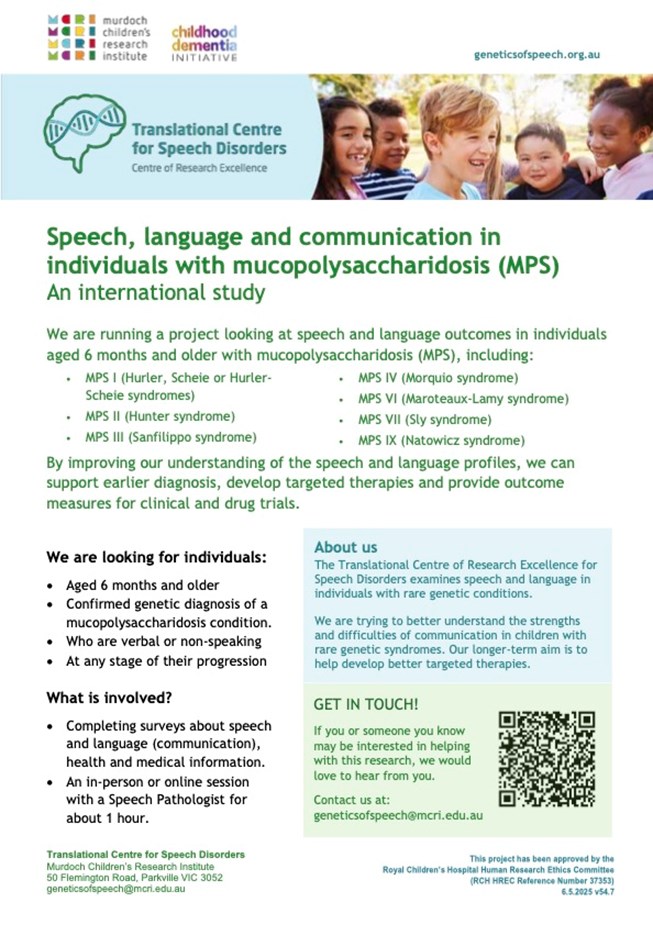
Speech, language and communication in individuals with mucopolysaccharidosis (MPS)
We are recruiting people with mucopolysaccharidosis (MPS) to participate in a speech and language study.
We are looking for individuals:
• Aged >6 months old
• Confirmed genetic diagnosis of a mucopolysaccharidosis condition
• Who are verbal or non speaking
• At any stage of their progression
What’s Involved:
• Surveys about speech and language (communication), health and medical information
• Online or in-person session with a speech pathologist
If you are interested in helping our research, please email us at geneticsofspeech@mcri.edu.au or sign up here
Motor speech treatment for childhood apraxia of speech (CAS) in genetic conditions
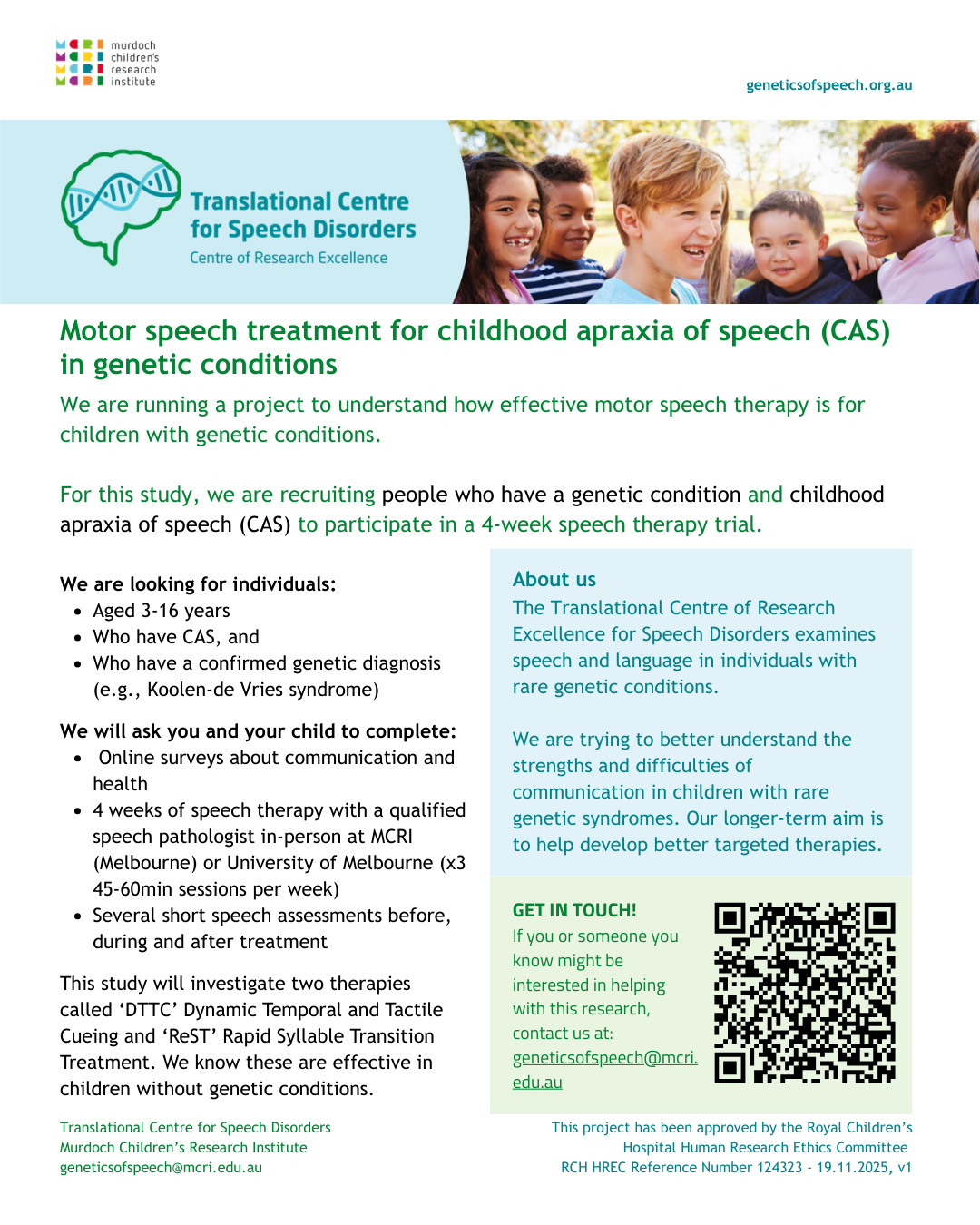
We are recruiting for a new study looking at how effective motor speech therapy is for children with genetic conditions. This study will investigate two therapies called ‘DTTC’ Dynamic Temporal and Tactile Cueing and ‘ReST’ Rapid Syllable Transition Treatment.
We are looking for individuals:
• Aged 3-16 years
• Who have CAS, and
• Who have a confirmed genetic diagnosis (e.g., Koolen-de Vries syndrome)
What’s Involved:
• Online surveys about communication and health
• 4 weeks of speech therapy in-person at MCRI (Melbourne) or University of Melbourne (x3 45-60min sessions per week)
• Several short speech assessments before, during, and after treatment
If you are interested in helping our research, please email us at geneticsofspeech@mcri.edu.au or register your interest here
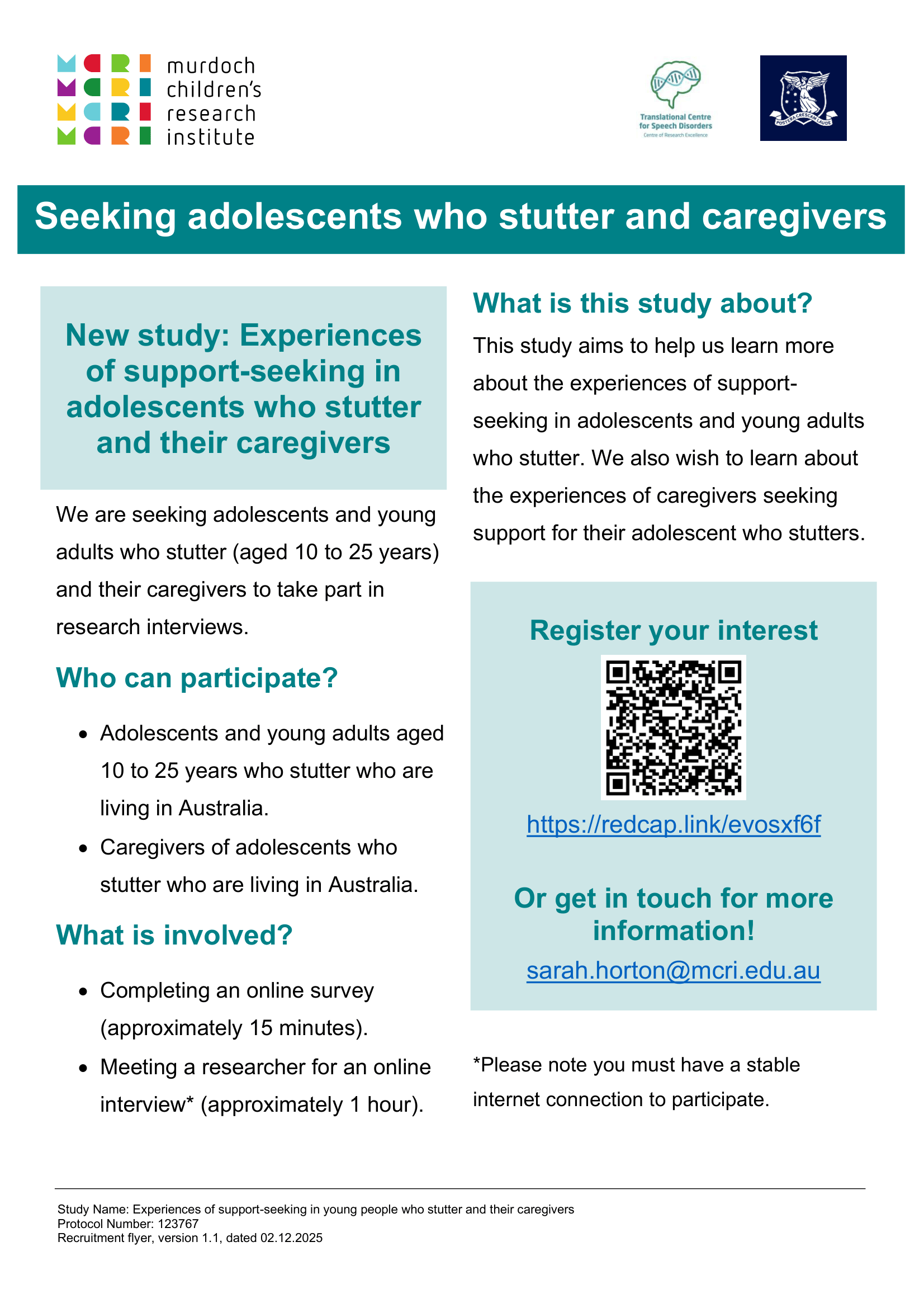
Experiences of support-seeking in adolescents who stutter and their caregivers
We are seeking adolescents and young adults who stutter (aged 10 to 25 years) and their caregivers to take part in research interviews.
We are looking for individuals:
• Adolescents and young adults aged 10 to 25 years who stutter who are living in Australia.
• Caregivers of adolescents who stutter who are living in Australia.
What’s Involved:
• Completing an online survey (approximately 15 minutes)
• Meeting a researcher for an online interview (approximately 1 hour)
If you are interested in helping our research, please email us at sarah.horton@mcri.edu.au or register your interest here
Speech, language, and feeding in individuals with KCNQ2-related condition
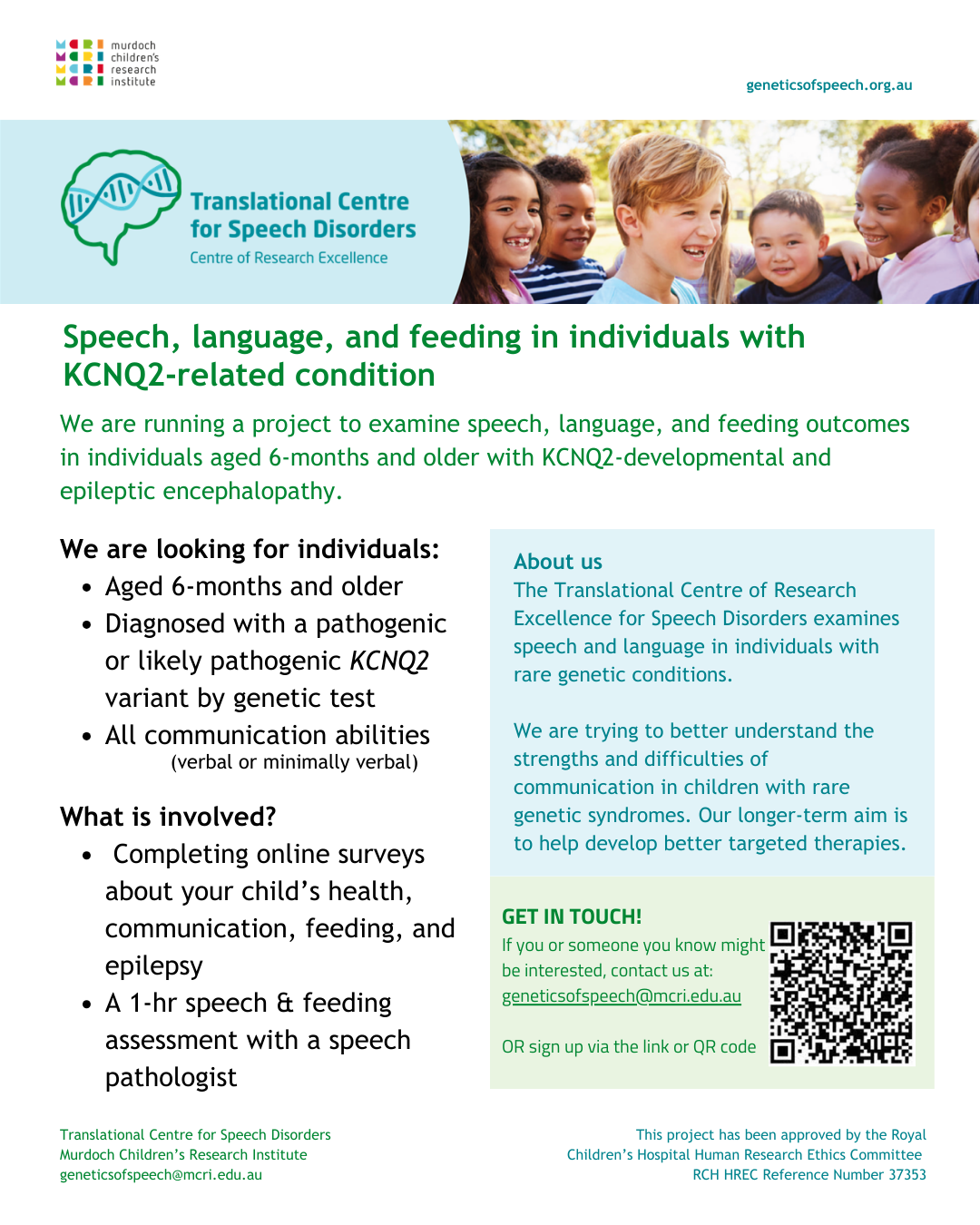
We are recruiting people with a KCNQ2 gene variant to participate in a speech and feeding study.
We are looking for individuals:
• Aged >6 months old
• Diagnosed with a KCNQ2 genetic variant, confirmed by genetic test
• All communication abilities (verbal or minimally verbal)
What’s Involved:
• Surveys about communication, epilepsy, and feeding
• Online or in-person speech and feeding assessment with a speech pathologist
If you are interested in helping our research, please email us at geneticsofspeech@mcri.edu.au or sign up here
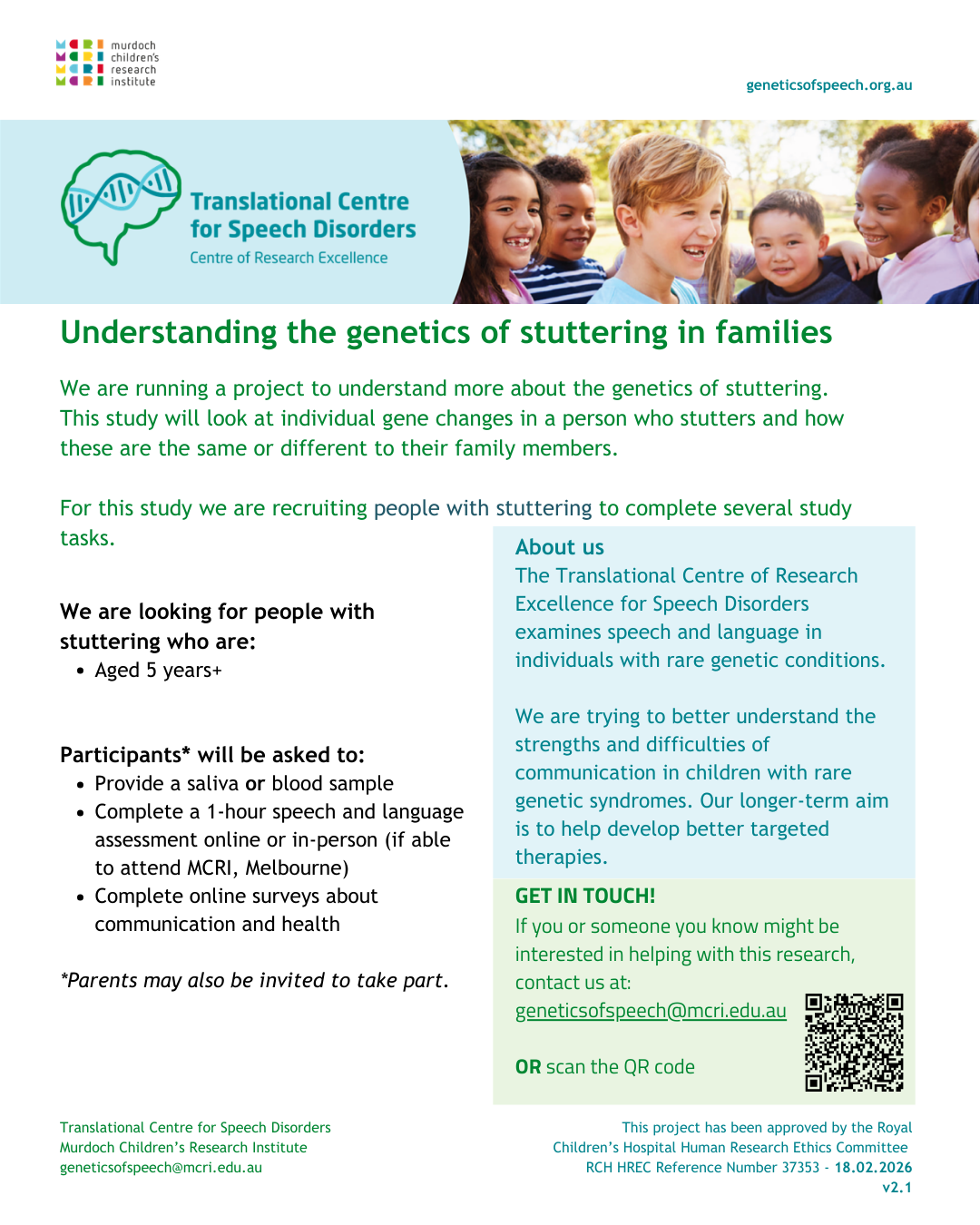
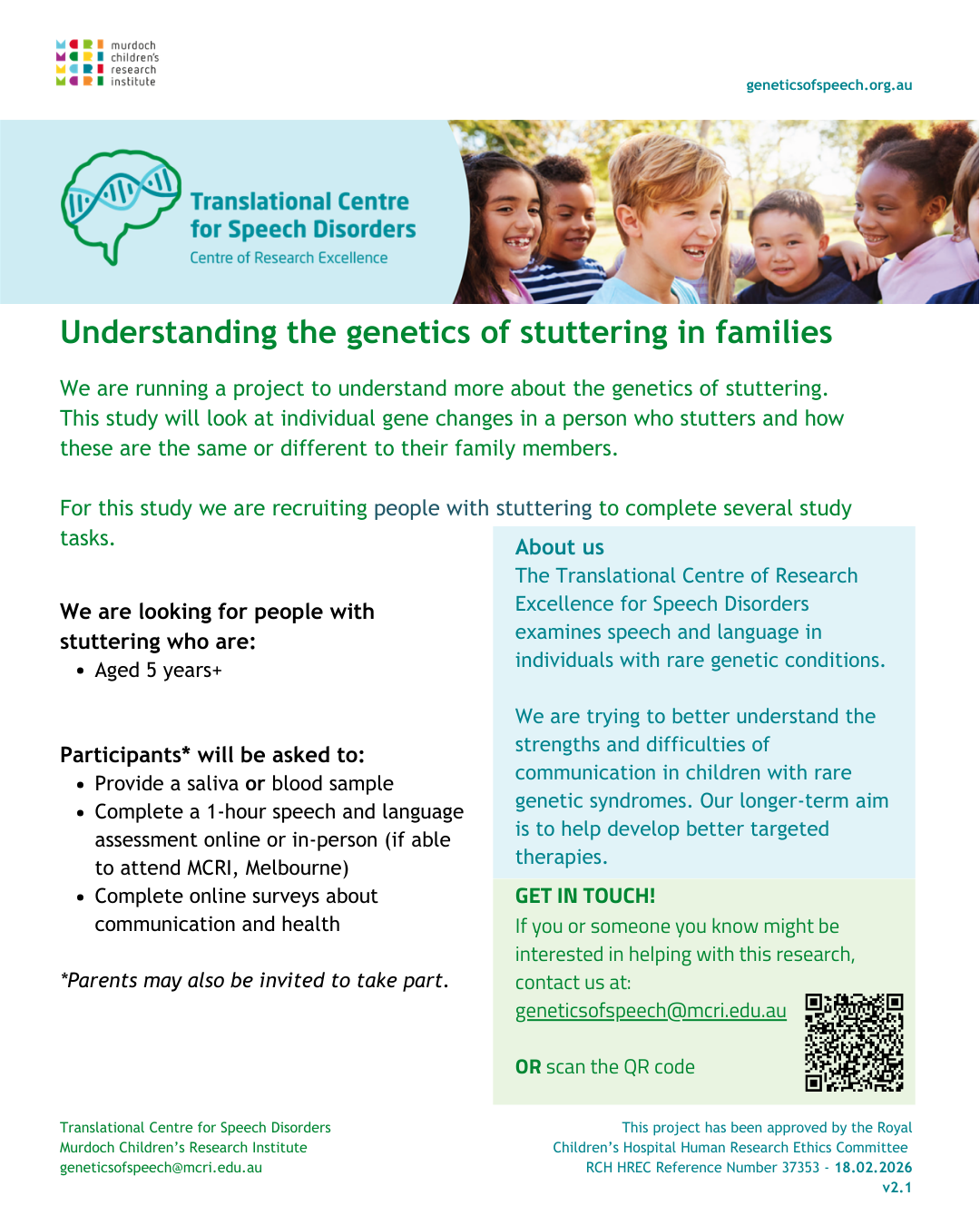
Understanding the genetics of stuttering in families
• Aged 5 years+
• Saliva or blood sample
• Surveys about speech, language, and health
• Online or in-person meeting
If you are interested in participating please email us at geneticsofstuttering@mcri.edu.au or register your interest here
See more information in our flyer here
High-tech augmentative and alternative communication for childhood dementia
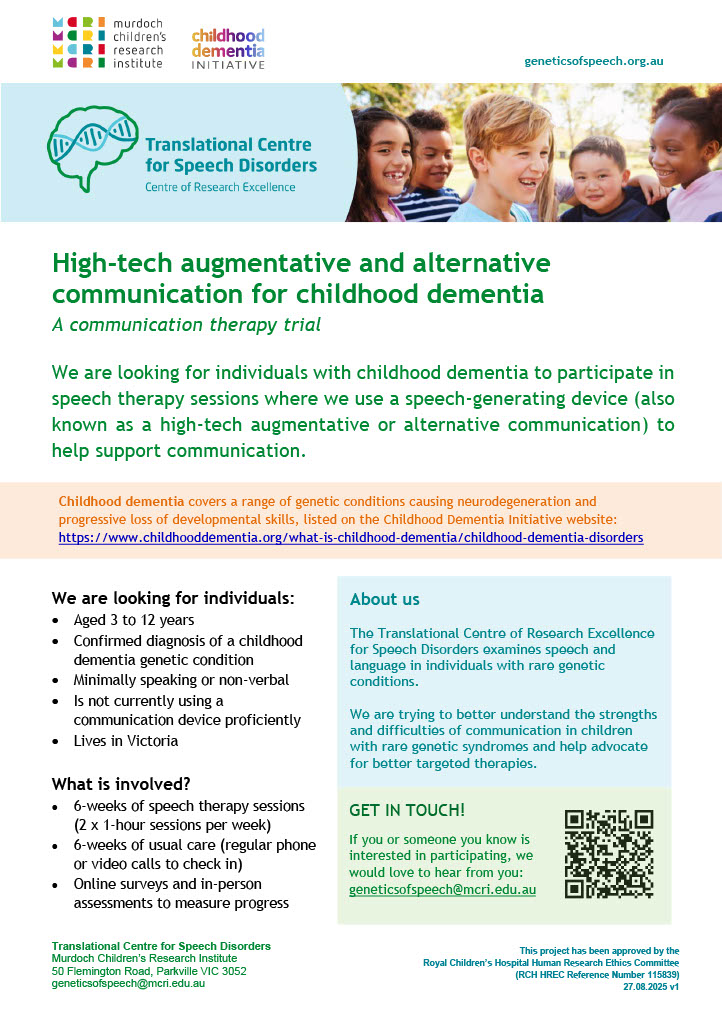
We are recruiting for a new study for individuals with childhood dementia to participate in a communication therapy trial.
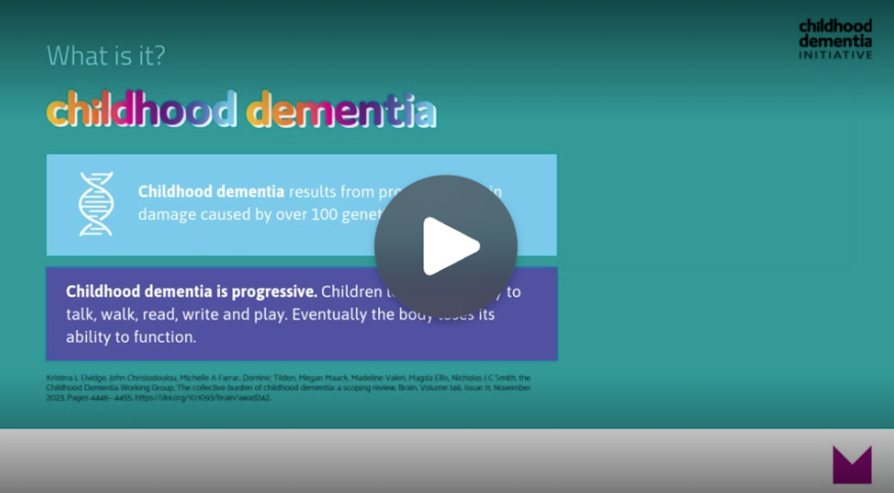
Want to know what encompasses childhood dementia? See more here
We are looking for individuals:
• Aged 3 to 12 years
• Diagnosed with a childhood dementia genetic condition
• Minimally speaking or non-verbal
• Not currently using a communication device proficiently
• Living in Victoria
What’s Involved:
• 6 weeks of speech therapy sessions (2 x 1hour sessions per week)
• 6 weeks of usual care
• Online surveys and in person assessments to measure progress
If you are interested in participating please register your interest here or if you have questions please email us at aactrial@mcri.edu.au
See more information in our flyer here
Learn more about the trial in this video here!
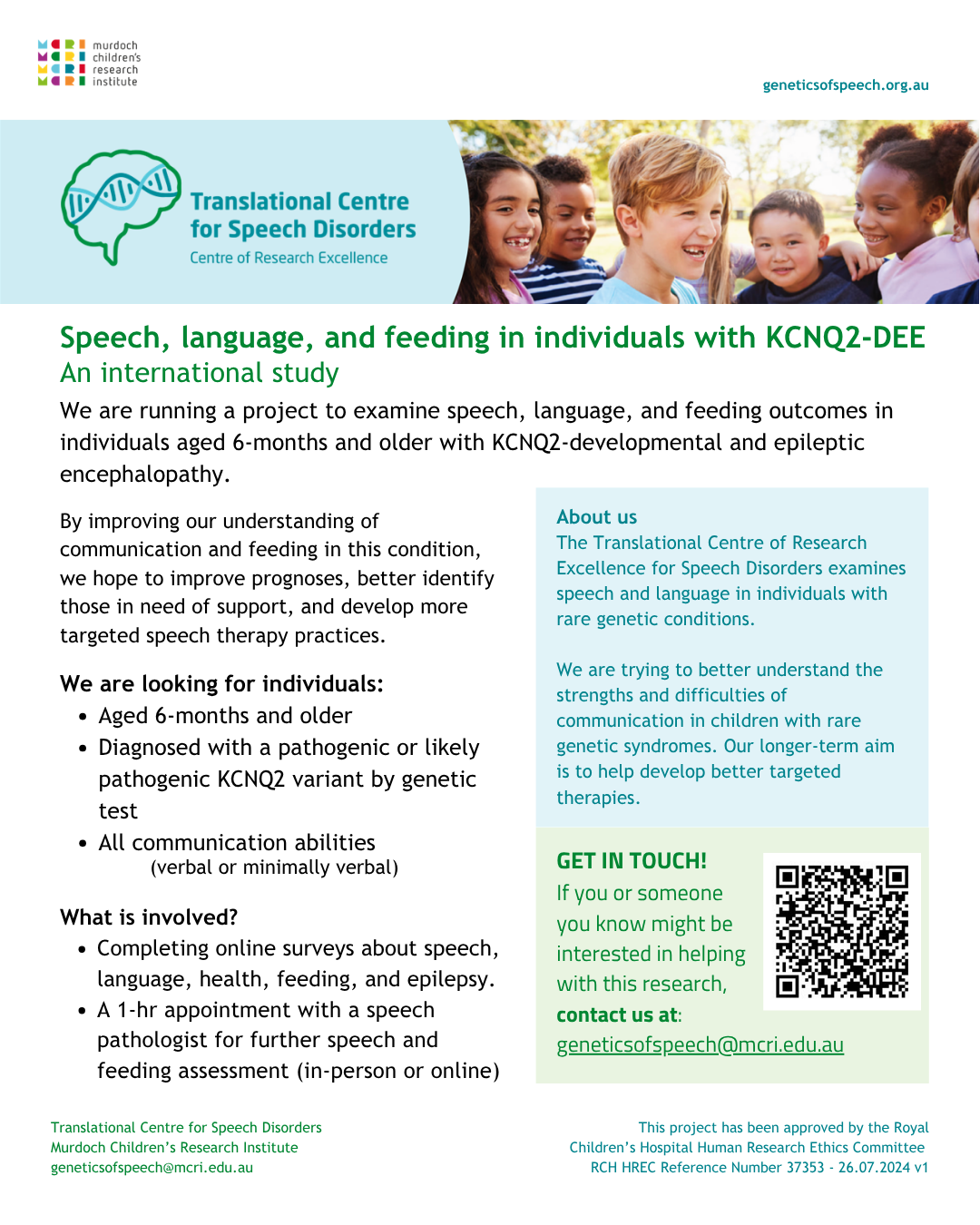
Speech, language, and feeding in individuals with KCNQ2-DEE
We are recruiting for a new study looking at speech, language, and feeding in people with KCNQ2 Developmental and Epileptic Encephalopathy.
We are looking for individuals:
• Aged 6 months to adulthood
• Diagnosed with a KCNQ2 variant by genetic test
• Verbal or minimally verbal
What’s Involved:
• Online or in-person meeting
• Surveys about communication, feeding, epilepsy, and health
• Surveys available in English, French, Dutch, German, Spanish, Portuguese, Italian, Polish, or Chinese
If you are interested in participating or have questions please email us at geneticsofspeech@mcri.edu.au or register your interest here
See more information in our flyer here
Okur-Chung neurodevelopmental syndrome (CSNK2A1-related condition)
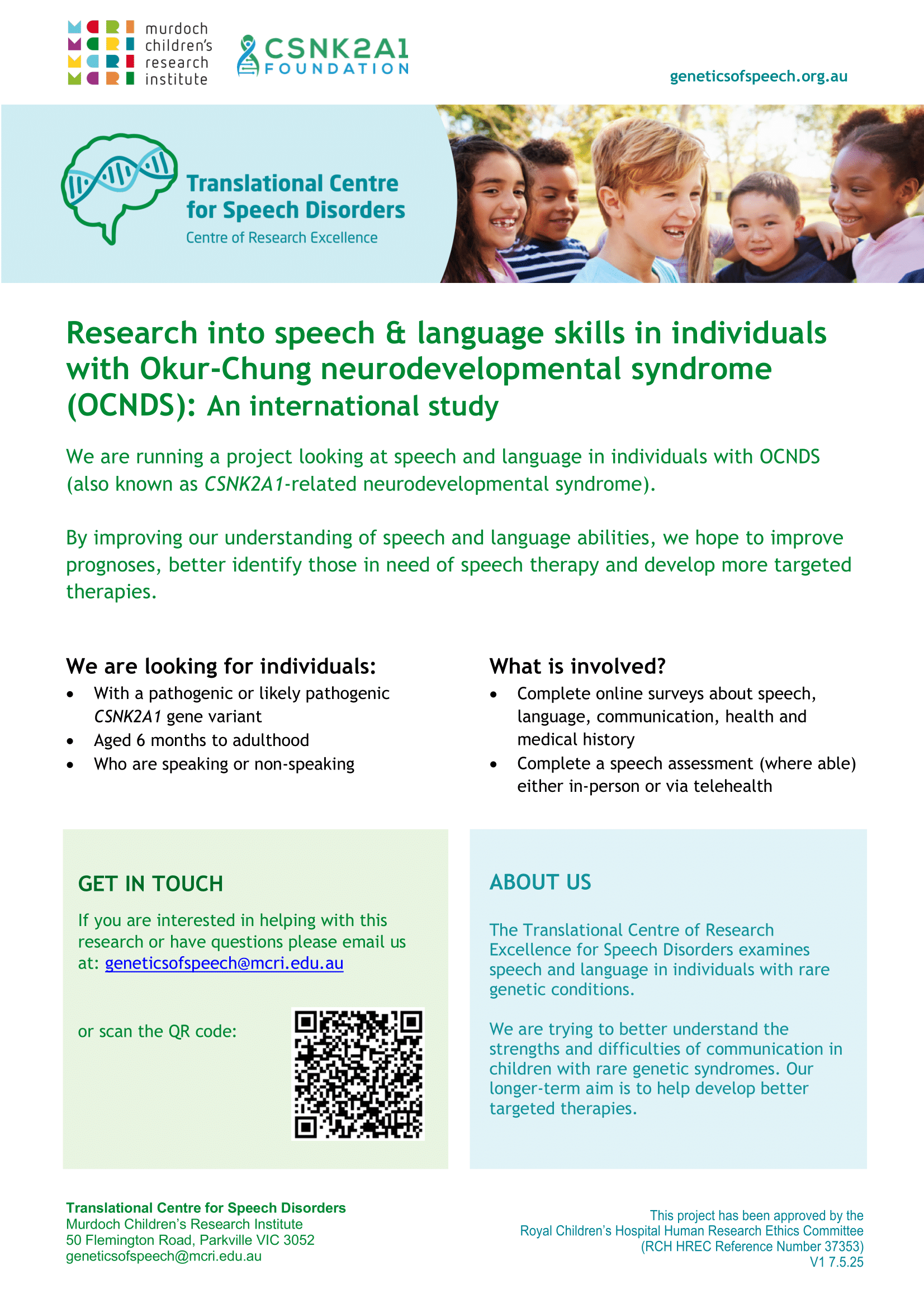
Our researchers are investigating speech and language in individuals with OCNDS (also known as CSNK2A1-related neurodevelopmental syndrome). By improving our understanding of speech and language abilities, we hope to improve prognoses, better identify those in need of speech therapy and develop more targeted therapies.
We are looking for individuals:
• With a pathogenic or likely pathogenic CSNK2A1 gene variant
• Aged 6 months to adulthood
• Who are speaking or non-speaking
What is involved?
• Complete online surveys about speech, language, communication, health and medical history
• Complete a speech assessment (where able) either in-person or via telehealth
This is an international study and surveys are available in English, French, Dutch, German, Spanish, Portuguese, Italian, Polish, or Chinese.
Please register your interest by emailing us at geneticsofspeech@mcri.edu.au Please see more information on the flyer here
Studies in specific genetic conditions
Researchers from the NHMRC Centre of Research Excellence - Translational Centre for Speech Disorders are currently investigating speech and language presentations in several genetic conditions. This knowledge will help us learn more about diagnosis of these conditions, prognosis for speech and language outcomes and assist in tailoring therapies and supports for individuals and their families. Research is currently being conducted in the following genetic conditions:
Okur-Chung neurodevelopmental syndrome (CSNK2A1-related condition)
If you are interested in learning more about these studies, please email us at geneticsofspeech@mcri.edu.au
Proudly in partnership with